BetLogic Introduces Prediction Engine V3: A New Framework for Football Forecasts
BetLogic has integrated Prediction Engine V3, a rebuilt framework for football match forecasting. The upgrade introduces a dedicated pre-match prediction model, stricter data validation, auditable decision records and controlled model learning. Historical predictions remain intact, while new capabilities are evaluated separately before their performance can be certified.
What is BetLogic Prediction Engine V3, and how does it improve the football forecasting process?
BetLogic Prediction Engine V3 is a rebuilt football forecasting framework introducing an independent pre-match goal model, point-in-time data validation, immutable prediction decisions and controlled model learning. It is designed to improve the consistency, traceability and evaluation of forecasts. Historical V1/V2 results remain separate, and increased accuracy or calibrated V3 probabilities have not yet been established through independent future-match evidence.
- Author
 By Ioan TudorFounder, BetLogic
- Publication date
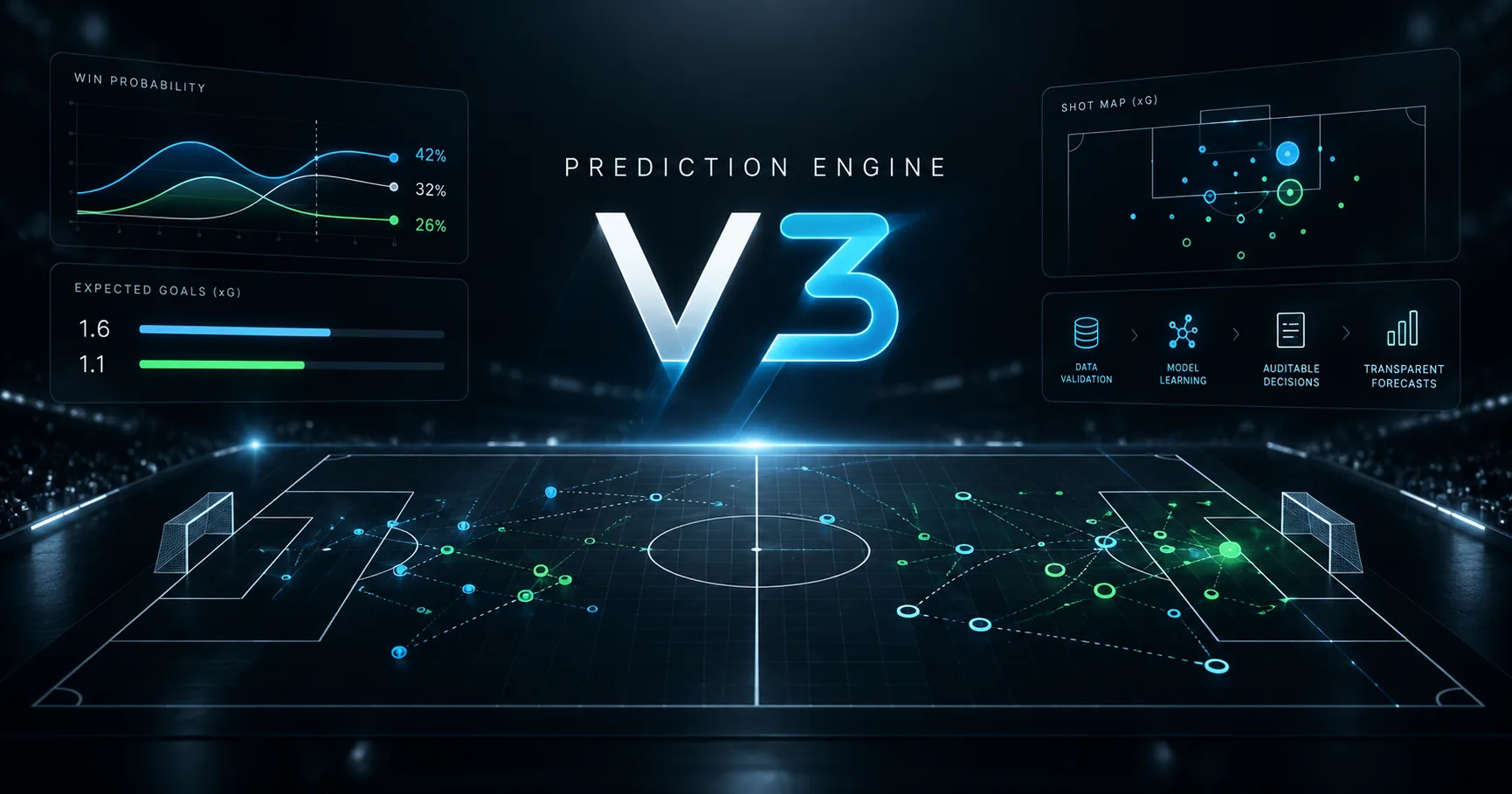
BetLogic has introduced Prediction Engine V3, a major upgrade to the technology behind its football forecasting platform. The new generation moves beyond incremental changes to individual prediction rules. It establishes a dedicated framework for analysing pre-match evidence, producing consistent forecasts, recording decisions and evaluating models against real football results. The objective is straightforward: make football predictions more systematic, transparent and accountable, while treating uncertainty as an essential part of forecasting.
A New Foundation for Football Predictions
Prediction Engine V3 introduces an independent pre-match forecasting model built around expected goals and the estimated distribution of possible scorelines. The framework considers historical team performances, attacking and defensive records, home and away form, and structured match context where reliable information is available. Its goal-based approach provides a consistent mathematical foundation for evaluating outcomes such as home wins, draws, away wins, total goals and both teams scoring. Unlike earlier rule-based approaches, Engine V3 separates its goal model from legacy confidence labels and selection rankings. This distinction matters because a prediction score is not automatically a statistically validated probability. Numerical forecasts require independent evaluation before they can be presented as calibrated estimates.
Better Data Discipline, Not Just More Data
One of the most important changes concerns how historical football information is evaluated. Engine V3 is designed to respect the information available before a match begins. Its historical evidence checks distinguish data captured before a prediction from information that only became available afterwards. This helps prevent a common modelling problem known as data leakage, where future information accidentally influences a historical prediction test. The system also checks whether enough reliable evidence exists to support a forecasting decision. Incomplete records, incompatible historical data or unavailable inputs are not automatically converted into confident predictions. The result is a more disciplined analytical process in which the quality and timing of evidence matter as much as the quantity of data collected.
When the Evidence Is Not Strong Enough, No Prediction Is a Valid Outcome
Football remains unpredictable, regardless of how sophisticated a forecasting system becomes. Engine V3 therefore distinguishes between a valid model decision, an intentional decision not to recommend a selection, and a technical situation in which a reliable forecast cannot be produced. For example, insufficient historical information or a temporary data-provider problem should not be treated as evidence that a particular football outcome is unlikely. The updated architecture records these situations separately, supporting controlled retries and clearer internal diagnostics. It also preserves the identity of a final pre-match decision so subsequent refreshes do not silently replace the original forecast. For readers, the principle is simple: BetLogic should not manufacture a prediction merely because a match appears on the schedule.
A More Structured Approach to Model Learning
Engine V3 introduces a controlled process for evaluating potential improvements to its pre-match goal model. Historical observations can support research, but a proposed model update must be assessed using chronological training, validation and independent holdout data. The framework also preserves the distinction between historical predictions created by earlier engines and decisions genuinely issued by Engine V3. This prevents historical results from being presented as evidence of a new model's performance when that model did not actually generate those forecasts. Model changes are not automatically promoted simply because an offline calculation produces encouraging results. The release process requires documented evidence and explicit approval before a new parameter set can replace the existing one. The purpose is to build a learning system that can improve through verification rather than unsupported assumptions.
What Changes for BetLogic Readers?
For football supporters using BetLogic, Engine V3 represents an investment in the quality of the forecasting process rather than a promise of guaranteed winning selections. The platform continues to provide match schedules, football analysis, prediction availability and historical performance records. Readers can review settled Main Tips through BetLogic's public Prediction Performance and Prediction Dataset pages, including predictions that missed. Those historical results remain part of the public record. They are not retrospectively attributed to Engine V3. Additional capabilities involving live-match forecasting and player-specific predictions are being developed within the broader Engine V3 architecture, but they require separate evidence, validation and release controls. BetLogic will assess the new engine using actual future results before making claims about improved accuracy or calibrated probabilities. The ambition is to build a more reliable foundation for football intelligence, with clear evidence behind every future performance claim.
Sources & References
- How BetLogic AI Football Predictions Work
BetLogic · BetLogic first-party reference
Official public methodology documenting data inputs, uncertainty, confidence treatment and prediction limitations. Engine V3 implementation details were additionally verified against the internal GitHub repository.
- BetLogic Prediction Performance | Transparent Football Prediction Results
BetLogic · BetLogic first-party reference
Public reporting methodology for settled Main Tips, landed and missed outcomes, market comparison and performance limitations.
- BetLogic Prediction Research | Settled Performance, Calibration and Failure Patterns
BetLogic · BetLogic first-party reference
First-party analysis describing historical calibration evidence, evaluation thresholds and recurring prediction errors. This is historical evidence, not a V3 performance certification.
- BetLogic Prediction Dataset | Settled Main Tip Results
BetLogic · BetLogic first-party reference
Public record of settled historical Main Tips, with outcomes and available confidence evidence.