AFCON 2027 qualifiers: November fixtures, key groups and host rules explained
AFCON 2027 qualifying resumes on 12 November. Here are the decisive double-headers, confirmed CAF dates and special rules for the three host nations.
AFCON 2027 qualifying fixtures 12 17 November 2026 group standings rules Nigeria Tanzania Morocco Niger
CAF confirms that AFCON 2027 qualifying Matchdays 3 and 4 will be played between 12 and 17 November 2026. The 48-team group stage has 12 groups; the three tournament hosts qualify automatically, changing the qualification rule in groups containing Kenya, Tanzania or Uganda.
- Author
 By Ioan TudorFounder, BetLogic
- Publication date
- Updated date
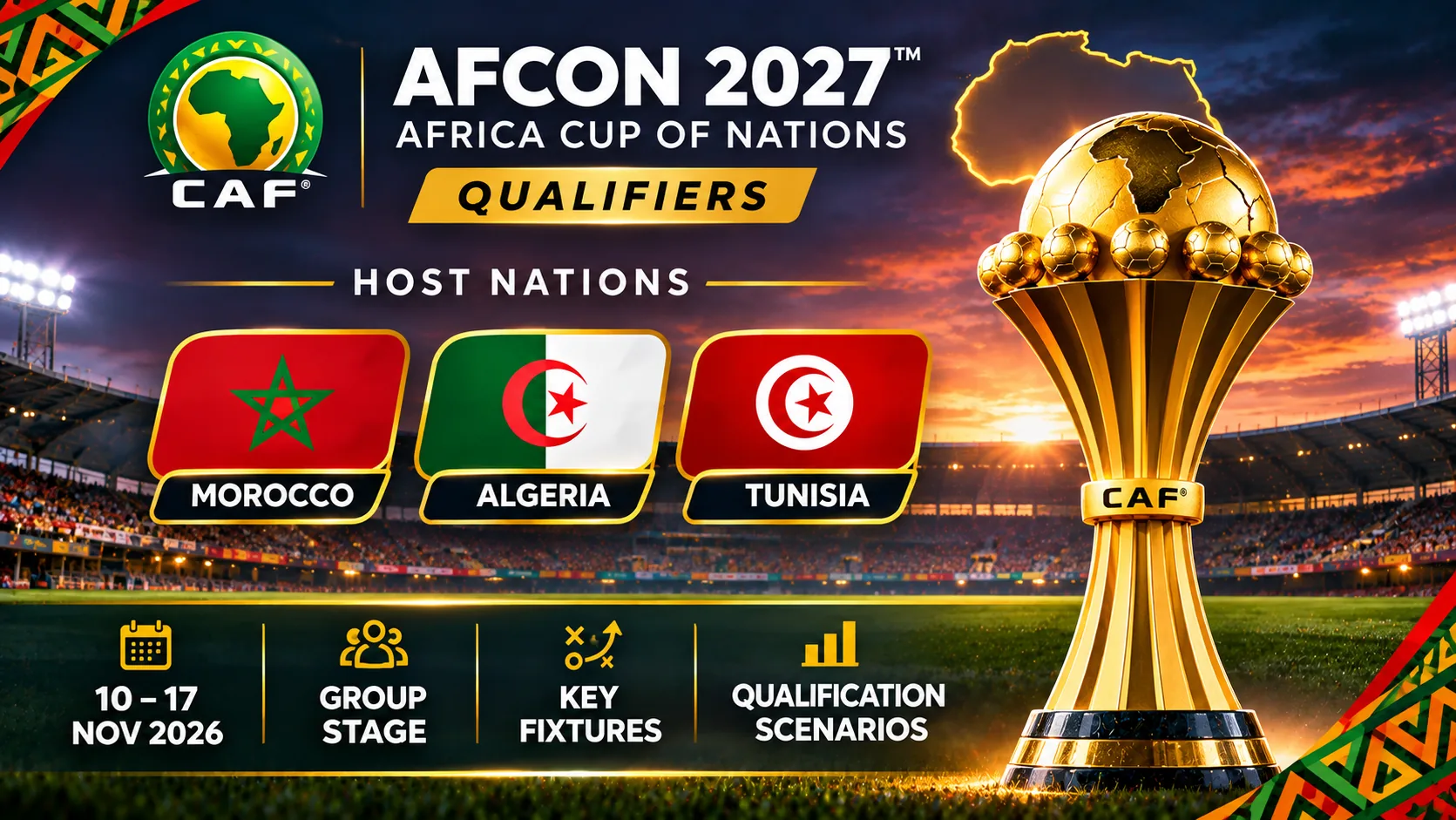
The November international window brings a pivotal stage in qualification for the 2027 Africa Cup of Nations, with matches between 12 and 17 November set to move the group stage beyond its halfway point. CAF has confirmed the updated programme for Matchdays 3 and 4, a sequence of closely spaced fixtures in which teams will face the same opponent twice. For countries that began with six points, the double-headers offer an opportunity to build a substantial cushion. For those with one or no points, the margin for another setback is considerably smaller.
The competition features 48 nations in twelve groups of four. The finals will be staged by Kenya, Tanzania and Uganda from 19 June to 17 July 2027. That three-country hosting arrangement creates a qualification rule readers should understand before interpreting the standings: the usual two-place model does not apply to groups containing one of the automatically qualified hosts.
The three hosts change the qualification arithmetic
Kenya, Tanzania and Uganda have already qualified for the finals as hosts, regardless of where they finish in their respective qualifying groups. In those three groups, only the highest-ranked team other than the host advances through the competition's qualifying process. In the other groups, the top two teams qualify. The distinction is especially important in Group L, where Nigeria must compete with Guinea-Bissau and Madagascar for the available non-host qualification place while playing Tanzania, one of the co-hosts.
Guinea-Bissau have taken six points from their first two Group L matches, while Nigeria have three. Tanzania's guaranteed place in the tournament does not reduce the importance of their matches: results against the co-host still affect the ranking of the teams fighting for the other ticket. Nigeria meet Tanzania on Friday, 13 November, with the return fixture on Tuesday, 17 November. Those matches carry more pressure than a conventional second-place finish would suggest.
Two meetings between group leaders demand attention
Group C offers one of the clearest direct tests of early form. Côte d'Ivoire and The Gambia both won their opening two matches and meet first on 12 November, with the return played five days later. Ghana, meanwhile, have yet to take a point and face Somalia twice. For the teams at the top, a positive double-header could establish real separation; for Ghana, points are urgently needed to avoid a qualification campaign that becomes more difficult to recover.
Group K has a similar direct confrontation. Mali and Rwanda each began with six points and meet on 13 November before the reverse fixture on the final matchday of this international window. No single result will automatically determine the final group order, but two fixtures against the closest competitor give both sides the opportunity to alter the table quickly. Those matches are particularly valuable for readers seeking competitive context rather than focusing only on the larger names.
Senegal, Sudan and the importance of Group J
Group J is tightly poised. Senegal and Mozambique each hold four points, with Sudan just one behind on three. Senegal host Sudan on 12 November and travel for the reverse fixture on 16 November, while Mozambique play Ethiopia twice. A single win, draw or defeat in these meetings could reshape the order at the top. The margins are close enough that goal difference and the results of direct encounters deserve attention alongside points.
Elsewhere, Morocco lead Group A with six points, with Gabon and Niger both on three. Morocco face Niger on 13 and 17 November in a particularly unusual pairing because both matches are scheduled in Morocco. CAF has confirmed that Niger cannot host its nominal home game in its own country because there is no approved stadium. That logistical detail is relevant to the competitive setting and should be reflected accurately in coverage.
The confirmed programme from 12 November
CAF's first slate on Thursday, 12 November includes Ghana–Somalia, Côte d'Ivoire–Gambia, Senegal–Sudan, Cameroon–Namibia and DR Congo–Sierra Leone, among other matches. The next day brings Nigeria–Tanzania, Morocco–Niger, South Africa–Kenya, Mali–Rwanda and Egypt–Malawi. Some groups continue their third-round fixtures on Saturday, 14 November before the reverse matches follow from 16 to 17 November.
These are the dates issued by the Confederation of African Football, not inferred from an unsynchronised score feed. Match times in CAF's schedule are stated in GMT and must be converted to the reader's local timezone when displayed. In Romania during November, GMT times are two hours behind EET. The exact official schedule should take precedence if an external calendar continues to label all the games as taking place on one earlier date.
What matters as the group stage approaches halfway
The main question in November is not simply which favourite will win its next fixture. It is how each result affects the available qualification places, particularly in the groups with an automatic host. Teams such as Guinea-Bissau, Rwanda and The Gambia have earned strong positions, while established names including Nigeria and Ghana must respond to early setbacks.
BetLogic's editorial approach is to separate confirmed dates, results and standings from forecasts of what might follow. The current tables establish the starting point for Matchdays 3 and 4; team news, selections and match events will determine the outcome. For supporters preparing to follow the window, the most valuable information is the correct schedule, the qualification structure and the competitive significance of the double-headers.
Sources & References
- Official AFCON PAMOJA 2027 Matchdays 3 and 4 preview
CAF · External reference · 2026-11-03
Authoritative dates, group standings, two-match pairings and host-group exceptions.
- AFCON 2027 format and co-host qualification rules
CAF · External reference · 2026-07-01
Tournament dates, main-stage format and three host groups.
- Group-by-group results following the first two matchdays
CAF · External reference · 2026-10-02
Verified group trends and early results.
- AFCON 2027 qualifiers fixture schedule
TNT Sports · External reference
Independent calendar corroboration for 12–17 November.